
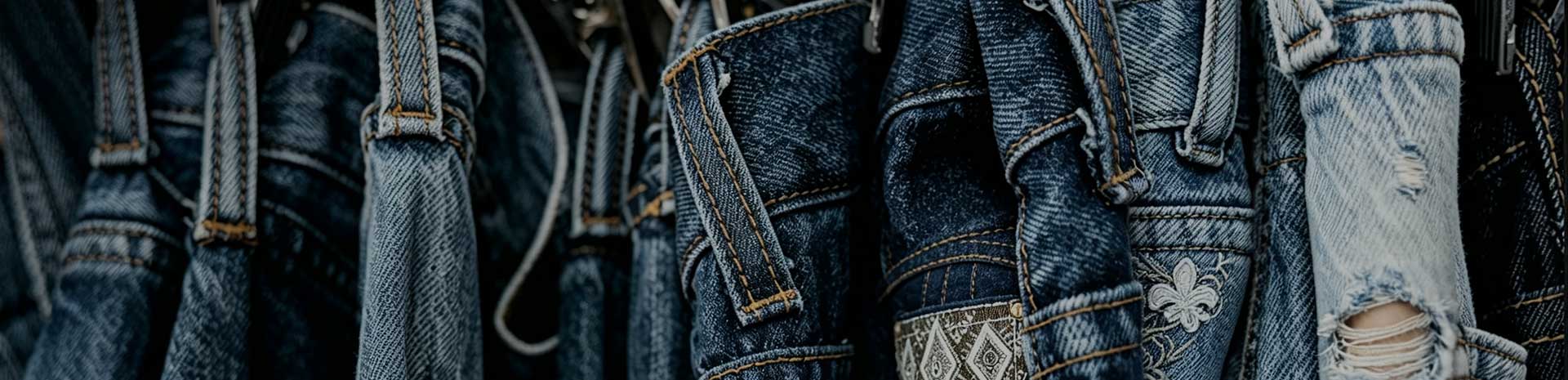
Decorative Pocket Jeans vs Classic Five-Pocket Jeans: Which Design Stands Out in Retail?
Decorative pocket jeans generally attract more visual attention through embroidery, contrast stitching, and ornamental details. Classic five-pocket jeans provide broader styling flexibility and a familiar denim appearance. For retailers and wholesale buyers, the better choice depends on customer preferences, brand positioning, pocket construction, manufacturing costs, and the commercial value of decorative features.
What Is the Difference Between Decorative Pocket Jeans and Classic Five-Pocket Jeans?
The main difference between decorative pocket jeans and classic five-pocket jeans is the treatment of their pocket construction and appearance. Decorative pocket jeans incorporate embroidery, distinctive stitching, embellishments, or modified pocket shapes, while classic five-pocket jeans emphasize a conventional denim pocket arrangement with relatively restrained decoration.
A traditional five-pocket jeans construction consists of two front pockets, one small coin pocket, and two back patch pockets.
This arrangement is widely recognized in denim manufacturing and remains a common starting point for many jeans patterns.
Decorative pocket jeans are not necessarily a separate pocket-layout category. They may retain the traditional five-pocket construction while adding ornamental details to the existing pockets.
This distinction matters for wholesale product descriptions because a pair of jeans with embroidered back pockets can still be classified as five-pocket jeans.
| Comparison Factor | Decorative Pocket Jeans | Classic Five-Pocket Jeans |
|---|---|---|
| Pocket Construction | Conventional or modified pocket layout | Two front pockets, one coin pocket, two back pockets |
| Main Appearance | Embroidery, embellishments, decorative stitching | Traditional pocket styling |
| Visual Differentiation | Often more noticeable | Generally understated |
| Design Development | Requires decoration specifications | Focuses on pattern and construction accuracy |
| Production Operations | May require embroidery or trim attachment | Standard pocket sewing operations |
| Material Requirements | Denim, threads, decorative components | Denim, pocketing, threads, standard trims |
| Quality Inspection | Pocket construction and decoration quality | Pocket construction and sewing quality |
| Customization | Artwork, stitching, pocket shape, hardware | Pocket dimensions, stitching, labels, hardware |
| Manufacturing Cost | May increase with decorative complexity | Often fewer decorative operations |
| Retail Positioning | Fashion-focused and statement denim | Classic and minimalist denim collections |
For denim brands, the distinction should be based on the approved product specification rather than treating the two categories as mutually exclusive.
Why Do Decorative Pocket Jeans Stand Out More in Retail Displays?
Decorative pocket jeans can attract attention because their additional visual details distinguish them from otherwise similar denim products.
Embroidery, decorative stitching, rhinestones, metal accents, and ornamental motifs introduce differences in color, texture, and surface appearance.
These details can be particularly noticeable on the back pockets, which occupy a recognizable position on the garment.
For example, dark indigo jeans with light-colored geometric embroidery create a different impression from jeans using the same fabric and silhouette with plain back pockets.
Decorative pockets can also help brands establish identifiable styling characteristics across multiple denim products.
A manufacturer may develop similar embroidery motifs on skinny jeans, bootcut jeans, and flared jeans while adjusting the artwork to suit each pocket shape.
However, greater visual attention does not automatically produce stronger retail sales.
A distinctive pocket design must still match the preferences of the intended customers.
Some retailers emphasize expressive denim, while others focus on minimalist clothing with limited decoration.
For wholesale buyers, decorative pockets create value when they support a recognizable product identity and a suitable retail price.
Why Do Classic Five-Pocket Jeans Remain Important for Fashion Retailers?
Classic five-pocket jeans provide a familiar construction that can be adapted to different silhouettes, fabrics, and washing finishes.
Their pocket layout remains consistent even when other garment features change.
For example, a women's denim collection may include five-pocket skinny jeans, straight-leg jeans, bootcut jeans, and flared jeans.
Each product can use a different pattern while maintaining the same general pocket arrangement.
This creates flexibility for retailers seeking a coordinated range of denim products.
Classic five-pocket jeans also allow brands to emphasize fabric appearance, fit, waistband construction, and washing treatments without relying on prominent pocket decoration.
A dark wash straight-leg style may suit an understated denim collection, while a light wash five-pocket style can provide a more casual appearance.
From a manufacturing perspective, the traditional pocket arrangement provides a recognizable reference for pattern development and quality inspection.
However, familiar construction does not automatically guarantee consistent quality.
Pocket symmetry, opening dimensions, stitching, reinforcement, and placement must still be controlled during production.
What Are the Five Pockets in Classic Jeans?
Classic five-pocket jeans generally feature two curved front pockets, one small coin pocket, and two back patch pockets.
The front pockets are integrated into the front garment panels, while the back pockets are attached to the rear panels.
The coin pocket is commonly positioned within or near the opening of one front pocket.
Its exact dimensions and placement vary according to the garment design.
The back pockets are typically constructed from separate denim panels with folded or finished edges.
Their size, shape, and positioning influence the appearance of the rear section.
Why Does Pocket Construction Matter?
Pocket construction affects both garment appearance and manufacturing consistency.
The front pockets require accurate cutting, pocket bag assembly, and reinforcement at stress points.
The back pockets require consistent placement relative to the center-back seam, yoke, and waistband.
For wholesale orders, manufacturers should document the pocket width, height, opening dimensions, seam allowance, and placement measurements.
A five-pocket garment should not be evaluated only by counting its pockets.
The construction quality of each pocket is equally relevant.
An accurately developed pocket pattern provides the foundation for both plain and decorative denim styles.
What Types of Decorative Pockets Are Used in Women's Jeans?
Women's decorative pocket jeans can incorporate several types of ornamental construction.
The selected detail depends on the brand's design direction, denim fabric, garment silhouette, and production requirements.
Embroidered Back Pockets
Embroidery uses decorative stitching to create motifs, lettering, geometric patterns, or ornamental details.
The artwork may use one or several thread colors.
Manufacturers must confirm the embroidery dimensions, stitch density, thread specifications, and placement.
Contrast-Stitched Pockets
Contrast stitching uses thread colors that differ visibly from the denim fabric.
For example, light beige or white stitching against dark indigo denim can emphasize pocket outlines and decorative patterns.
Stitch spacing and alignment become important quality-control considerations.
Embellished Pockets
Some women's jeans incorporate rhinestones, studs, beads, or metal decorations.
These components require suitable attachment methods and inspection procedures.
The manufacturer should assess whether the decorations remain secure during normal use and the intended care process.
Shaped or Layered Pockets
Decorative pockets may also use modified outlines, overlapping panels, flap details, or additional stitching lines.
These constructions can create distinctive appearances without relying entirely on embroidery or separate ornaments.
For private-label buyers, the selected decoration should be confirmed through an approved physical sample before bulk production.
How Does Pocket Decoration Influence Brand Identity?
Decorative pockets can become part of a denim brand's recognizable visual identity.
A repeated embroidery motif, signature stitch pattern, or coordinated ornament arrangement can create consistency across different jeans silhouettes.
For example, a clothing brand may apply related geometric embroidery to high-waisted skinny jeans and dark wash bootcut jeans.
The two products can retain different fits while sharing a recognizable decorative detail.
This approach allows brands to create coordinated collections without using identical garment patterns.
However, decorative elements should be evaluated in relation to the entire product.
An elaborate pocket may compete visually with distressed fabric, prominent washing effects, or other decorations.
A simpler motif may be more suitable when the jeans already contain several noticeable design features.
From a product-development perspective, the question is not how many decorative elements can be added.
The more relevant consideration is whether the pocket treatment strengthens the brand's intended visual direction.
For wholesale collections, consistent decoration can also support product photography and merchandising when it is reproduced accurately across production batches.
How Are Decorative Pocket Jeans Manufactured?
The manufacturing process depends on the selected pocket treatment.
For embroidered pockets, decoration is often completed on separate fabric panels before the pockets are attached to the jeans.
This allows the embroidery machine to operate on relatively flat fabric pieces.
The embroidery design must be converted into a machine-readable stitch file and evaluated using the selected denim.
The production team should confirm thread tension, stitch density, stabilizing materials, and motif placement.
After embroidery, the pocket panels are folded, pressed where appropriate, and attached to the garment.
For pockets using studs, rhinestones, or other decorative components, the attachment sequence may differ.
Some details may be added after pocket assembly or garment washing, depending on their compatibility with the production process.
Classic five-pocket jeans generally require fewer decorative preparation operations.
However, both constructions involve accurate cutting, pocket assembly, sewing, finishing, and inspection.
A useful manufacturing principle is that decorative pocket quality depends on both the decoration process and the underlying pocket construction.
A visually attractive embroidery design cannot compensate for an incorrectly positioned or poorly sewn pocket.
What Technical Specifications Should Buyers Provide for Decorative Pockets?
Decorative pocket development requires more information than a general reference photograph.
Wholesale buyers should supply an approved artwork file or clearly defined decoration requirements.
The technical specification should identify pocket dimensions, motif measurements, placement, thread colors, decorative materials, and attachment methods.
| Technical Parameter | Buyer Requirement |
|---|---|
| Pocket Width | Confirmed in the approved measurement chart |
| Pocket Height | Based on the selected jeans pattern |
| Decoration Type | Embroidery, contrast stitching, embellishments, or layered construction |
| Artwork Size | Exact motif width and height |
| Artwork Placement | Distance from approved pocket reference points |
| Thread Specifications | Approved material, color, and stitch characteristics |
| Decorative Hardware | Material, size, finish, and attachment method |
| Pocket Seam Allowance | According to the approved construction specification |
| Washing Compatibility | Evaluated using the intended finishing process |
| Inspection Criteria | Approved appearance and acceptable variation |
For example, a buyer may establish a provisional placement tolerance of ±5 mm for selected embroidery or pocket positions.
This is an illustrative manufacturing agreement rather than a universal industry standard.
The appropriate tolerance depends on garment size, decoration complexity, fabric characteristics, and buyer requirements.
For embroidery, the approved stitch file should be maintained for repeat production.
Changes to thread colors, stitch density, or artwork dimensions should be reviewed before the next manufacturing batch.
Does Pocket Decoration Affect Denim Fabric Performance?
Pocket decoration can influence fabric behavior, particularly when embroidery or embellishments introduce additional stiffness or concentrated tension.
Dense embroidery may restrict fabric movement in the decorated area.
This can be particularly relevant when the jeans use stretch denim.
The pocket fabric may extend during wear while the embroidery stitches provide less flexibility.
If the stitch construction is unsuitable, the decorated section may pucker or distort.
Metal embellishments and other attached components can also introduce localized stress.
The manufacturer should evaluate the selected attachment method and its compatibility with the denim fabric.
For rigid denim, embroidery may produce a different appearance because the base fabric has less elastic extension.
However, rigid denim is not automatically better for every decorative technique.
The finished result depends on fabric weight, yarn construction, embroidery density, and the selected finishing process.
For bulk orders, the decoration should be evaluated on the actual production fabric rather than an unrelated sample material.
Which Pocket Design Is More Suitable for Stretch and Rigid Denim?
Both decorative and classic pocket constructions can be used with stretch or rigid denim.
The main consideration is whether the pocket design remains suitable for the fabric's behavior.
Decorative Pockets on Stretch Denim
Stretch denim requires attention to how embroidery and embellishments respond to fabric extension.
For fitted jeans, pocket panels may experience movement around the hips and seat.
An overly dense embroidery motif may create visible distortion or reduce flexibility in the decorated area.
Manufacturers should therefore evaluate stitch construction, stabilizing materials, and pocket placement.
Decorative Pockets on Rigid Denim
Rigid denim may provide a relatively stable foundation for some decorative operations.
However, heavy embroidery or multiple embellishments can still affect pocket flexibility and surface appearance.
Needle selection, thread tension, and fabric thickness require consideration.
Classic Pockets on Both Fabrics
Classic five-pocket construction can be developed using either material type.
For stretch denim, the manufacturer should control sewing tension and prevent unnecessary fabric distortion.
For rigid denim, seam allowances and reinforcement should be compatible with the fabric thickness.
Neither pocket style should be selected without reviewing the chosen fabric and garment pattern together.
Are Decorative Pocket Jeans More Expensive to Manufacture?
Decorative pocket jeans may require additional manufacturing expenses because embroidery, embellishments, or complex stitching introduce extra materials and processing operations.
However, the exact difference depends on the selected design.
A small embroidered motif may require relatively limited additional work.
A large multicolor design with high stitch density can involve longer machine time and more detailed preparation.
Decorative hardware may introduce separate sourcing and attachment costs.
For example, an embroidery design containing 6,000 stitches will generally require different processing resources from a design containing 18,000 stitches under comparable production conditions.
These values are illustrative examples, not specifications for a particular LOVEU JEANS product.
The final embroidery cost should be calculated from the approved artwork, machine settings, production quantity, and finishing requirements.
Classic five-pocket jeans generally avoid some of these decorative operations.
However, a plain-pocket garment using premium denim, complex washing, or specialized construction may cost more than a simpler decorative-pocket style.
For wholesale quotations, the complete garment specification should be compared rather than evaluating pocket design in isolation.
Can Decorative Pocket Jeans Support Higher Retail Prices?
Decorative pocket jeans may support higher retail prices when the target customers recognize the additional design work as desirable.
However, higher manufacturing costs do not automatically translate into higher consumer willingness to pay.
The value of a decorative pocket depends on the brand's market positioning and the appeal of the finished garment.
For example, a boutique specializing in embellished women's denim may treat embroidered back pockets as an important selling feature.
A retailer focused on minimalist denim may prefer plain pockets even when decorative versions are available.
Wholesale buyers should evaluate the expected retail price alongside the additional manufacturing cost.
The relevant commercial measure is whether the decoration contributes enough revenue or customer demand to justify its expense.
Brands can compare similar jeans patterns with decorative and classic pockets to evaluate customer reactions.
Using comparable fabrics, washes, and retail channels helps reduce differences caused by unrelated product features.
Actual sell-through, reorder activity, customer feedback, and margins provide stronger evidence than assuming embroidery automatically increases product value.
Which Design Is Easier to Maintain During Bulk Production?
Classic five-pocket jeans may involve fewer decorative production variables because they do not require additional artwork, embroidery threads, or ornamental components.
However, pocket symmetry and sewing accuracy remain essential.
Decorative pocket jeans require the same construction controls plus inspection of decorative details.
For embroidered pockets, the manufacturer should check motif alignment, thread consistency, loose stitches, puckering, and artwork accuracy.
For embellished pockets, inspection may involve attachment security, surface condition, and missing components.
The finishing process may introduce additional challenges.
For example, garment washing can change the appearance of embroidery threads or affect certain decorative attachments.
A finished-garment sample should therefore establish the approved appearance.
For repeat orders, maintaining the approved artwork, component references, and pocket construction specifications helps reduce inconsistencies.
A useful production distinction is that classic pocket jeans primarily require consistent pocket construction, while decorative pocket jeans require consistent construction and decoration performance.
Both aspects should be reflected in the quality-control plan.
What Quality Tests Apply to Decorative Pocket Jeans?
Quality requirements depend on the type of decoration and the selected denim fabric.
Embroidery should be inspected for thread integrity, stitch consistency, color changes, and fabric distortion.
Attached decorative components may require suitable attachment-strength testing where applicable.
The relevant testing procedure and acceptance criteria should be agreed upon before production.
For both decorative and classic pocket jeans, fabric and garment evaluations may include:
| Test Standard | Evaluation Purpose |
|---|---|
| ISO 105-C06 | Colorfastness to laundering |
| ISO 105-X12 | Colorfastness to rubbing |
| ISO 5077 | Dimensional changes after washing and drying |
| ISO 13935-2 | Seam maximum force using the grab method |
| ISO 13934-1 | Fabric tensile properties using the strip method |
These standards address particular material or construction properties.
They do not independently certify the overall quality of a decorative pocket design.
For embroidery, the appearance after the intended washing process may also require visual inspection against an approved reference.
For rhinestones, studs, or other attachments, the inspection plan should consider applicable component requirements and the product's destination market.
Actual test results are necessary before claiming compliance with any specific performance standard.
How Do Washing Processes Affect Decorative and Classic Pockets?
Washing can influence the appearance and dimensions of both pocket styles.
Classic five-pocket jeans require inspection of shade consistency, seam appearance, pocket alignment, and finished garment measurements.
Decorative pockets introduce additional considerations.
Embroidery thread may respond differently from the surrounding denim during washing.
Decorative metal components can also be affected by certain finishing methods.
The manufacturer should evaluate whether decoration is best applied before or after the selected garment wash.
For example, embroidery completed before washing may develop a different appearance from embroidery added to a finished garment.
Neither sequence is automatically correct for every product.
The suitable approach depends on the artwork, thread materials, denim fabric, and intended wash effect.
For wholesale buyers, the approved sample should represent the final garment after all decorative and finishing processes have been completed.
A pocket design approved before washing should not automatically be accepted as the finished production standard.
The final appearance, dimensions, and component condition must be reviewed.
Which Design Works Better with Skinny, Straight-Leg, and Bootcut Jeans?
Both pocket styles can be incorporated into multiple women's jeans silhouettes.
The appropriate choice depends on the brand's intended appearance and the relationship between pocket dimensions and garment proportions.
Skinny jeans may use embroidered pockets to create a decorative focal point against a fitted silhouette.
Straight-leg jeans can retain classic five-pocket construction for understated styling.
Bootcut jeans may incorporate decorative embroidery to complement vintage-inspired details.
Flared jeans can use either approach depending on the collection's visual direction.
| Jeans Silhouette | Decorative Pocket Direction | Classic Five-Pocket Direction |
|---|---|---|
| Skinny Jeans | Embroidery and ornamental back pockets | Simple fitted denim |
| Straight-Leg Jeans | Subtle motifs or contrast stitching | Classic denim styling |
| Bootcut Jeans | Floral or geometric embroidery | Traditional denim appearance |
| Flared Jeans | Decorative, retro-inspired details | Silhouette-focused styling |
| Dark Wash Jeans | Strong contrast with lighter decorations | Clean indigo appearance |
| Light Wash Jeans | Coordinated embroidery and trims | Relaxed casual appearance |
These examples represent product-development possibilities rather than confirmed retail rankings.
Manufacturers should confirm pocket dimensions and placement for each jeans pattern.
A pocket developed for a skinny jeans sample may not maintain the same proportions when transferred directly to a larger bootcut or relaxed-fit pattern.
How Do Decorative Pockets Affect Private Label Customization?
Decorative pockets provide opportunities for private-label brands to establish distinctive garment details.
Custom embroidery, pocket shapes, stitching colors, and decorative hardware can help differentiate products.
For example, a brand may develop a signature geometric motif used across several jeans silhouettes.
The artwork can remain recognizable while its dimensions are adjusted to match different pocket patterns.
Plain five-pocket jeans also support customization.
Brands can modify pocket dimensions, topstitching, rivets, buttons, woven labels, and leather patches without incorporating prominent embroidery.
The appropriate approach depends on the desired brand identity.
For custom development, buyers should provide artwork files, reference samples, or technical drawings.
At LOVEU JEANS, pocket design can be discussed alongside denim fabric, garment fit, washing effects, and private-label requirements.
Our team can review the proposed construction and decoration specifications before confirming sample-development arrangements.
For repeat production, approved artwork and physical references should be maintained to support consistent manufacturing.
Which Design Is Better for Different Retail Markets?
Decorative pocket jeans may be suitable for fashion retailers whose customers actively seek embellished denim and noticeable garment details.
Classic five-pocket jeans may support retailers emphasizing traditional denim styling, understated clothing, or broad casualwear assortments.
However, retail suitability cannot be determined solely by geographic location.
A fashion boutique in Miami may serve a different customer group from a denim wholesaler in Los Angeles.
Similarly, retailers operating within the same city can have different product preferences and pricing strategies.
Buyers should evaluate their customer base rather than assuming a specific region prefers embroidered or plain pockets.
For wholesale sourcing, useful evidence includes previous sales records, retail feedback, reorder frequency, product returns, and customer requests.
A distributor supplying multiple retailers may choose to carry both styles when demand supports the assortment.
The better design is the one that matches the intended customer's preferences while maintaining acceptable manufacturing costs and retail margins.
How Can Wholesale Buyers Compare the Commercial Value of Both Designs?
Wholesale buyers should compare decorative and classic pocket jeans using equivalent garment specifications wherever possible.
For example, two jeans samples can share the same silhouette, denim fabric, washing treatment, size range, and hardware while using different pocket treatments.
This creates a more focused basis for evaluating the decorative feature.
The buyer can then compare manufacturing cost, expected retail price, customer response, and sales performance.
Relevant commercial considerations include:
Additional cost of embroidery or embellishment.
Expected retail price difference.
Customer interest in decorative details.
Fit-related and decoration-related returns.
Reorder frequency.
Inventory turnover.
Gross profit per garment.
A decorative pocket may justify higher manufacturing costs if it supports stronger customer demand or a suitable retail premium.
However, a plain-pocket product may provide greater commercial value when customers prioritize fit, wash shade, and price.
The objective is not to determine which design appears more complicated.
It is to identify which product produces a better commercial outcome for the intended retail channel.
Should Denim Brands Include Both Designs in One Collection?
A denim collection can include both decorative pocket jeans and classic five-pocket jeans when the products serve different customer preferences.
Classic five-pocket jeans may establish the foundation of a traditional denim assortment.
Decorative pocket jeans can add visual variety and more distinctive product details.
For example, a brand may introduce dark wash straight-leg jeans with plain pockets alongside embroidered bootcut jeans.
Another collection may use decorative pockets on high-waisted skinny jeans and conventional pocket construction on relaxed straight-leg styles.
The assortment should reflect actual customer demand rather than an assumed requirement to carry every variation.
From a manufacturing perspective, brands may coordinate fabric sourcing, buttons, labels, and packaging where specifications permit.
However, decorative and classic pocket styles should retain their individual approved samples and technical requirements.
Embroidery, embellishments, and pocket assembly may introduce different production schedules and inspection procedures.
A coordinated collection benefits from shared design direction, but each product must still meet its own approved specification.
What Should Buyers Check Before Ordering Decorative Pocket Jeans in Bulk?
Buyers should evaluate decorative pocket jeans using an approved finished garment sample.
The sample should confirm the intended pocket shape, decoration placement, thread colors, attachment method, and washing appearance.
For embroidered pockets, the artwork should match the approved file and physical reference.
For embellished pockets, buyers should review component placement, attachment security, and compatibility with the intended care process.
Pocket construction should be inspected separately from decorative workmanship.
The technical package should record fabric composition, garment measurements, pocket dimensions, decoration specifications, washing requirements, and packaging.
For classic five-pocket jeans, inspection should emphasize pocket symmetry, opening dimensions, seam construction, reinforcement, and finished appearance.
Both styles require accurate size grading and post-wash garment measurements.
Buyers should also confirm the acceptable variation between finished pieces.
For decorative designs, some aesthetic variation may be acceptable depending on the selected process.
However, the permitted range should be agreed upon before bulk production.
Clear specifications help reduce misunderstandings between design teams, manufacturers, and wholesale purchasers.
Decorative Pocket Jeans vs Classic Five-Pocket Jeans: Which Stands Out More in Retail?
Decorative pocket jeans generally stand out more visually because embroidery, ornamental stitching, and embellishments create distinctive design features.
Classic five-pocket jeans provide broader styling flexibility and remain suitable for traditional, casual, and minimalist denim collections.
For fashion brands seeking recognizable decorative details, custom pockets may create stronger product differentiation.
For retailers prioritizing classic styling and fewer decorative operations, conventional five-pocket jeans may be more appropriate.
Neither style guarantees higher sales or better profitability.
The final decision should consider customer preferences, manufacturing costs, quality requirements, and actual retail performance.
From a production perspective, decorative pockets require additional attention to artwork accuracy, material compatibility, and decoration consistency.
Classic five-pocket construction requires careful control of pocket placement, stitching, and garment proportions.
The most valuable pocket design is not necessarily the most elaborate one. It is the design that strengthens the finished jeans while matching customer expectations and the brand's commercial objectives.
Develop Custom Decorative and Classic Pocket Jeans with LOVEU JEANS
LOVEU JEANS focuses on denim product development for clothing brands, wholesalers, importers, and distributors seeking different women's jeans styles and customization options.
Our team can discuss decorative pocket jeans, embroidered back pockets, contrast stitching, classic five-pocket construction, and private-label details according to your product requirements.
Custom development may include skinny jeans, straight-leg jeans, bootcut jeans, flared jeans, and denim styles with different washing treatments.
For decorative designs, buyers can provide embroidery artwork, reference images, pocket dimensions, preferred thread colors, and hardware specifications.
For classic five-pocket jeans, discussions may focus on pocket construction, garment measurements, denim weight, wash shade, and branded components.
Approved samples and clear technical documentation provide the basis for quotation, production planning, and quality inspection.
Contact LOVEU JEANS to discuss custom pocket jeans, request a wholesale quotation, and share your OEM/ODM requirements for your next women's denim collection.